


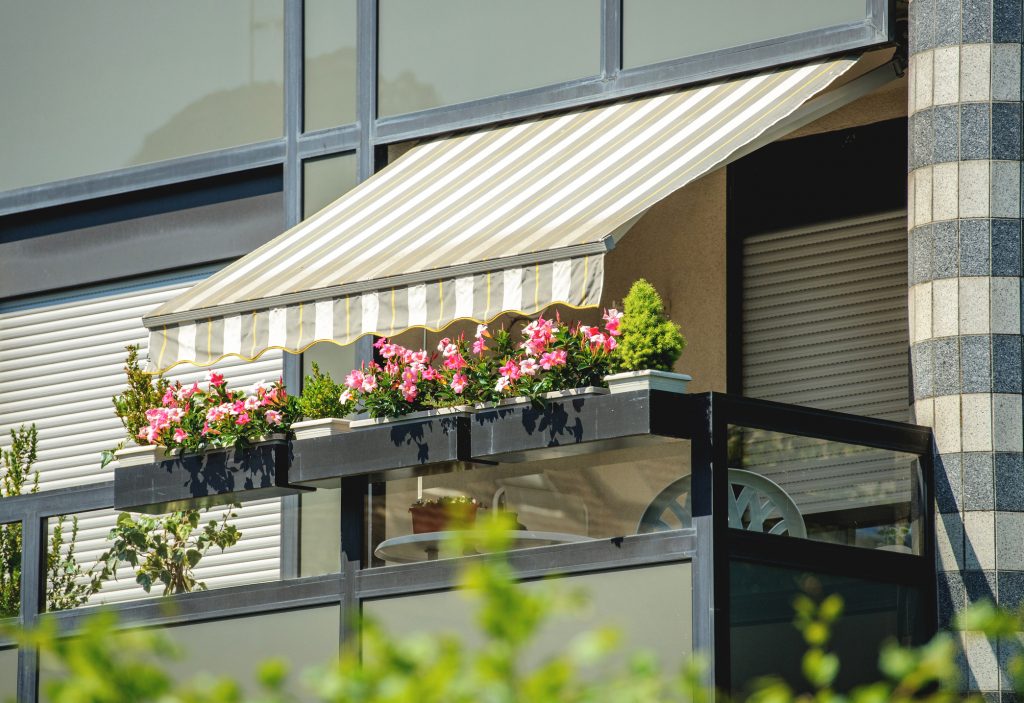
To have a comfortable environment inside your home, you need to provide a shaded environment outside, protected from the sun. The easiest way to do this is to install balcony awnings. When we talk about balcony awnings, we are actually referring to protecting the balcony from the scorching sun and extreme heat, from torrential rain, hail or extreme wind, which can fill the space with dust.
These awnings allow you to protect the balcony and the room it serves by closing it, partially or completely, but they can also protect terraces or even areas of facades, such as the facade of a store. Their purpose is to create comfortable temperature conditions in summer and protection from the elements in winter.
Features of balcony awnings
Even if it doesn’t seem like it, the subject has a sufficient breadth, which actually makes it adaptable to the conditions it tries to solve. The term balcony awnings is a term that reveals to us the different solutions that some awnings solve and in which specific locations.
The balcony awning is ideal for shading balconies, creating thermal comfort in the summer, and in the winter it protects the balcony from wind, rain, and snow. It is also very effective in blocking sunlight and dust in the summer.

We have established so far that there are awnings that close balconies, that close terraces in the same conditions, partially or completely, that are vertical or horizontal, but can be both horizontal and vertical at the same time. They can be fixed awnings or they can be retractable awnings, the movement being driven manually or mechanically. All this forces us to divide awnings and where appropriate to give them their specific names.
The material from which awnings are made is not an ordinary textile material, it is generally a polyester and Teflon-based material, very resistant to tearing, UV radiation and dirt, rain and wind, with excellent water resistance, partially waterproof, resistant to mold, oil, salts and stains. The awning material is efficient and elegant, preventing fading due to exposure to sunlight.
Different types of awnings
According to the position in which they stand to provide shade, awnings are:
- Vertical awnings are those used in apartment buildings, covering the balcony from the upper floor to the railing. Although called vertical, they have a slope due to the attachment.
- Horizontal awnings are those used for shading terraces, being attached to walls or where poles are needed. There are also models that have their own fastening system like a frame, on which the awning is attached. The position is at least 15° below the horizontal, so as not to hold water.
- Mixed, horizontal and vertical awnings , i.e. two-way, are horizontal awnings that have a vertical extension for additional shading, generally used on terraces.
- Awnings that shade only part of the wall , mounted above the door or window, not only on the balcony or terrace, but also at the main entrances of buildings, shops or storefronts, are called awnings. Awnings also have the function of shading and protection against the weather.
- Awnings that horizontally cover lightweight pole constructions, mainly for shading, on uncovered balconies or terraces are called pergolas.
According to the method of attachment, awnings are:
- Fixed awnings , which are attached in 3 or 4 points, depending on their shape and the surface to be shaded. The fastening straps provide tension that keeps the awning perfectly stretched, which prevents the formation of creases and water pockets, making it invulnerable to the wind.
- Mobile awnings that have a line of attachment fixed to a wall or ceiling, and by extending a mechanism they can be stretched and positioned on the surface they will shade.

Awnings are divided according to the mechanism that can extend them into:
- Simple vertical awnings , one of the simplest and cheapest solutions, being represented by a brake mechanism, which can lower the lower edge of the awning freely when the brake is released. This edge ends with a metal bar that serves as a weight, with hooks at the ends for attachment. A variant of this mechanism is for the bar that serves as a weight to be attached at both ends to bars that articulate with the wall and in this way the lowering and retracting movements are much safer. Once lowered, the awning is brought into position and attached by hooks to the edge of the balcony. When retracted, the fixing hooks are released and the mechanism is activated to tighten the awning. It should be emphasized that this style of awning when tightened will completely release the covered surface, only the two fixing hooks remain mounted on the railing.
- Fixed frame awnings for balconies are the ideal solution that provides not only shading, but also high resistance to wind or rain. The system contains a fixed aluminum frame on which the movable part of the awning slides, and when it is closed, the fixed frame remains visible.
- Awnings with side arms are those awnings that are operated by a system that contains a fixed aluminum frame, on which the movable part of the awning slides. When tightened, the fixed frame remains visible, but ensures very good resistance to wind, sun and rain.
- The retractable awning with articulated arm mechanism is an awning clamped between two fixing bars, one on the wall movable and one free, the two are joined by two articulated arms, fixed at the ends. The two articulated arms are tensioned by springs that tend to straighten them, in this way they will in turn tension the awning. By releasing the awning from the movable support in the wall, the articulated arm tends to straighten, extending the awning to the maximum position, it being always stretched. When retracted, the articulated arms tighten together with the awning.
Mobile awnings have the extension mechanism:
- With manual operation , when using a rotating handle that acts on a mechanism, it will cause the awning to extend onto the frame for which it was designed.
- With electric drive , when the mechanism that extends or contracts the awning is operated by an electric motor, by pressing a button or even by remote control.

