


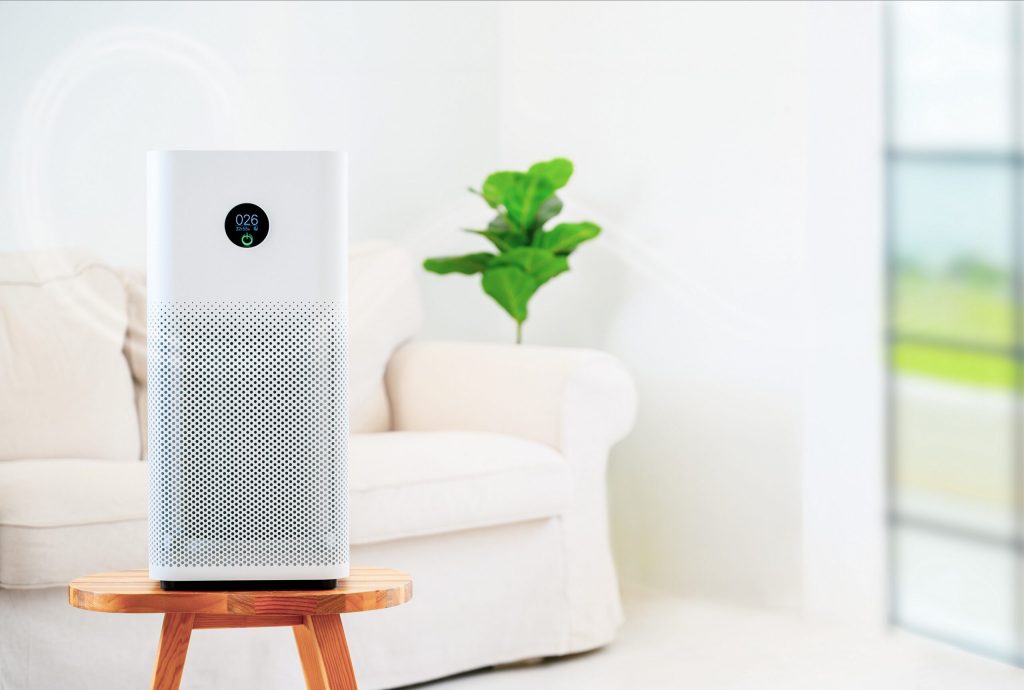
Air pollution is one of the most important causes of health problems affecting the population of large cities. We are not talking only about dust, but also about toxic microparticles that in the long term lead to deterioration of health. It is important that when we live in a city with a high level of pollution to protect our family in the long term, using an air purifier, a device that filters the polluted air in the home.
An air purifier is a household appliance increasingly sought after by buyers in industrialized areas or large urban areas, to provide added comfort or health. The air purifier, which initially appeared in the industrial environment, was later adopted by designers of residential or office buildings with air conditioning and ventilation systems as technologies improved and became cheaper. Since most homes around the world did not have a centralized air circulation system, the next step was the emergence of a compact air purifier.
Often called portable, although its size or weight does not always recommend it for moving, an air purifier uses simplified industrial technology to reduce costs and is packaged in a small and elegant housing that can be integrated into the home.

Useful functions of air purifiers
An air purifier for home use offers a fairly wide range of features, starting from simple air humidity adjustment to advanced filtration or disinfection options. To make a good choice, it is good to think very seriously about your real needs, because a model that does “everything” is either bad or very expensive.
From a technological point of view, an air purifier has functions that can be divided into three categories: air filtration, air sterilization, and humidity control.
1. Air filtration
The air filtration function is the most important function of an air purifier. Regardless of the nature of the filtration system, the purifier will circulate the air and remove suspended particles from the air, thus eliminating not only silicate dust, i.e. real dust, but also soot, ash, plant fluff, and other particles that pollute the city air. In addition to particles coming from outside, the air inside will contain particles of dry skin, insufficiently rinsed hygiene products that have dried, cigarette smoke, pet dander, mold spores, germs or the organic residues of dust mites.
To filter the air, air purifiers use:
- Hepa filters are the most common and most effective filtration method, these filters are available in several varieties, depending on the size of particles they can intercept and their storage capacity. This filter intercepts 99.7% of particles larger than 0.3 microns.
- Electrostatic filtration is similar to ionization, using an electric current with lower voltages and higher intensities. Electrostatic filtration is more efficient and does not produce ozone, but the device is larger and consumes more energy. Electrostatic filtration is always combined with a Hepa filtration system, and for this reason it is expensive and rarely found.
- Water curtain filtration is a rare technology, specific to air purification devices that also include a humidifier, that forces air through a water spray that traps particles in the air. However, the devices require careful maintenance and regular water changes.
Air purification devices can filter not only particles, but also harmful gases.
- Activated carbon filtration is always offered in partnership with a Hepa filter because the technology is only capable of intercepting gases, not particles. Filtration reduces toxic fumes or unpleasant odors, but the activated carbon filter must be changed quite often.
- Photocatalytic filtration uses an ultraviolet lamp, also useful for sterilization, to activate a titanium oxide catalyst, which in turn releases electrons that dissociate water vapor into oxygen and highly reactive OH- ions, which react with volatile chemicals and change their composition. It’s a rare good technology.

2. Air sterilization
Air sterilization is a rarer function that aims to eliminate germs from the air. To achieve this goal, there are several technologies that can fight bacteria, mites, and other microorganisms.
- Ultraviolet sterilization is an effective method that subjects the entire air flow to a bombardment of UV rays, but this is unfortunately quite rare and sometimes too expensive.
- Sterilization by incineration is rare, involving passing air through a heated element at temperatures of 200-300 degrees. Effective, the method is rarely found in a compact air purifier because it is expensive, consumes a lot of energy, and requires an air cooling element that is noisy.
3. Air humidity control
The human body needs a relative humidity level between 40 and 50%. Too much humidity will lead to overheating of the body and cause discomfort that affects mental balance, performance and rest during sleep, but it is also a factor that can aggravate some diseases such as asthma and allows the proliferation of certain pathogens. Too low a value causes dehydration, irritates the respiratory tract and makes it difficult to filter pathogens from the inhaled air, while also causing an increase in the amounts of mold and dust, with all the allergies they cause.

Depending on your needs, you can opt for humidification or dehumidification functions.
dehumidifier
Depending on the technology, dehumidifiers can use different solutions:
- The refrigeration dehumidifier basically works like the condensing stage in the air conditioner, but it is more inefficient and very noisy;
- The thermoelectric dehumidifier is a more advanced version of the above model, using a Peltier heat pump to condense the water. It is completely silent and compact.
- The water curtain dehumidifier works by cooling water below room temperature, washing the air stream and managing to lower its temperature enough to trigger natural condensation. This method is also used to filter particles from the air.
- The ion dehumidifier is an advanced, expensive and rare solution that uses a special membrane to which a weak electric current is applied. Through electrolysis, water vapor is converted into hydrogen and oxygen ions, which recombine into water, this time in a liquid state.
humidifier
- The natural vaporization humidifier is very simple and extremely inexpensive, it only uses a water tank and a wick that is placed in front of an air stream.
- The thermal vaporizer humidifier uses a small electrical resistance that heats water in a tank.
- The water curtain humidifier is the non-cooling version of the dehumidifier that uses the same technology, using very fine jets of water that are sprayed by a stream of air.
- The ultrasonic humidifier uses a ceramic surface that vibrates at very high frequencies, atomizing the water into particles smaller than one micron and thus facilitating its very rapid dispersion.

