


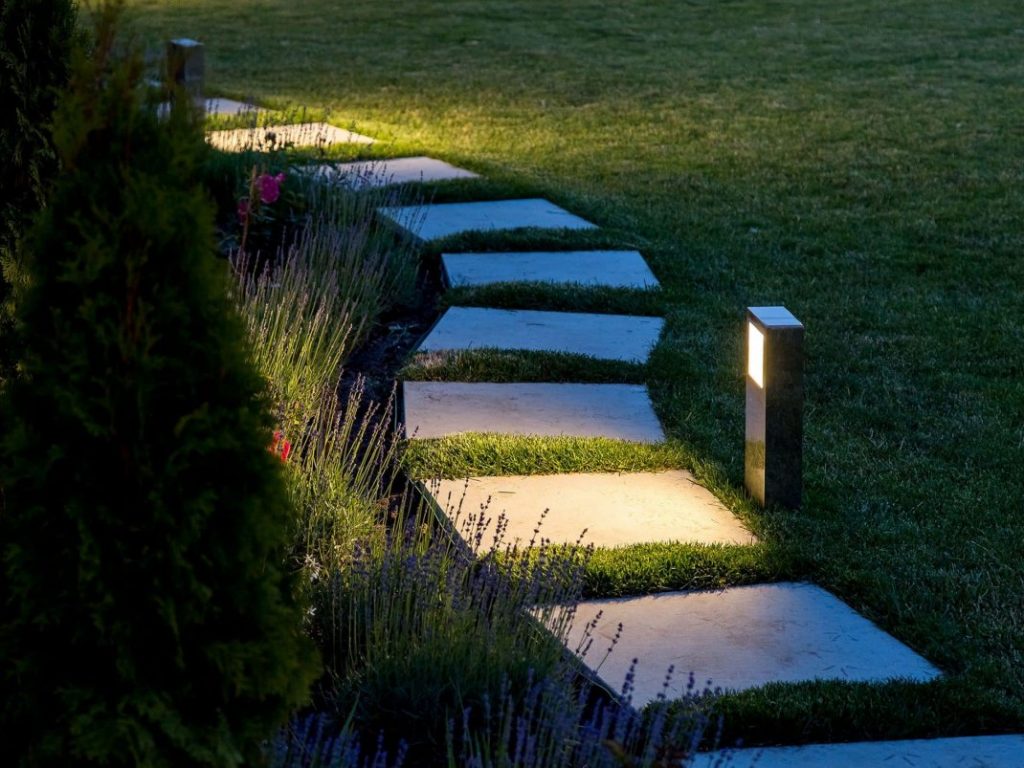
Summer is that time of year when we make the most of our outdoor spaces, gardens, and terraces. They are a fantastic place to spend evenings with friends and family, but above all, we can relax after work surrounded by our loved ones. The garden must certainly be properly landscaped and cared for because, until the autumn rains come, it is an oasis of relaxation at home.
Outdoor lighting is an essential element to create a pleasant environment for relaxation, and once arranged as it should be, we will not always have to take care of it. With the right garden lighting, you can truly enjoy the garden, pond, meadow, and terrace when the evening comes. Light up both the path that guests have to follow to get to the table and the table itself.
You can also light certain points that you want to emphasize or a certain detail. But don’t overdo it. If you bathe the garden in spotlights, you ruin any atmosphere. Rather, place accents with garden lighting and let individual plants shine as a form of light, for example.
What you need to know about garden lighting systems
- Garden lighting systems operate outdoors and you need to make sure you only use materials such as lights, cables, transformers and other electrical components that have a sufficient protection class to work in water and even snow.
- You should also consider that installation work with 230 volts can only be carried out by an expert.

- With a transformer you can adjust the voltage from 230 volts to 6, 12 or 24 volts, a voltage at which you can work without special training. You can then connect a wide variety of lights to these voltages with thin cables. You can either place them above ground or underground.
- A very good idea is to request the installation of fixed sockets in the garden and also to ensure that there are enough switches to turn off certain circuits when needed.
- Garden lighting systems that operate at 230 volts are preferably buried at a depth of 60 to 80 cm so that they are not affected by gardening work. Plan to run cables everywhere in the garden, even if you do not need them at that time.
- It is preferable to have several cables pulled through the tubes, later you will pull them much harder. It is good to leave a telegraph line on each route to pull cables if needed.
- Technology creates comfort, LED has revolutionized lighting in general and garden lighting in particular, with low consumption, up to 10,000 hours of operation and can be installed with low voltage systems.
- If you don’t want to bury cables, use solar lights that absorb light during the day and emit it in the evening.
- A warm white light below 3,000 Kelvin is particularly suitable for garden lighting. Also, the building should not be completely illuminated so as not to destroy privacy.
- A garden lighting system has an aesthetic component and a second functional one.

Garden lighting systems
- Functional garden lighting around the house and around the gate. In the entrance area, you don’t have to skimp on the light, the house number, name and bell immediately attract attention, guests are welcomed and uninvited guests are kept away. Lights with motion detectors are suitable for this, illuminating the area around the house. The lights are automatically activated with a twilight switch when dusk comes.
- Functional garden lighting on paths and stairs. It can be lamps or floor lamps on the path from the gate to the entrance door and then to the terrace, to the table or to the relaxation area, to show where to go. So that steps in the dark do not become dangerous, there are already built-in spots that serve as orientation aids without glare. For stairs, wall-mounted spotlights are suitable, which illuminate the course of the stairs, so that accidents do not occur.
- Functional and aesthetic lighting of the terrace, gazebo or relaxation area . If the respective areas are in close proximity to the house, they will be included in the house’s exterior lighting system. If they are at some distance, they will be illuminated with a similar highlighting system at dusk. In these areas, meals can be prepared and eaten, or games or other activities can be played that require stronger exterior lighting that will be provided by a local functional lighting system. Here, too, there is an aesthetic lighting system with garlands of light bulbs, possibly of various colors, which is automatically turned on by the twilight sensor, but only when needed.

- Aesthetic garden lighting . Light chains hung from the tops of trees or shrubs, following the contours of hedges, are great garden lighting systems in summer but can work just as well in the winter landscape, when snow also lights up the scene. Dimmable lighting that can be adapted to the garden lighting situation is particularly convenient. There is a second outdoor lighting that can highlight, from ground level, certain shrubs or flower arrangements. This garden lighting system has the same way of functioning in summer, but snow can cover it and make it non-functional in winter.
- Functional and aesthetic lighting of the pond or swimming pool. This includes functional accent lighting to avoid accidents, as well as aesthetic lighting that shows us the brilliance of the water with a few lamps below its level. Modern lighting systems are designed so that they can be installed both at the edge of the pond and in the garden pond or swimming pool, i.e. underwater. The goal is not to make the pond lighting as bright as day, but only to highlight individual points of view. For example, a sparkling waterfall, sparkling fountains or underwater plants.
Spotlights fixed to the bottom of the pond are particularly mystical. Skillfully aligned, they make some dreams come true. If there is not enough space for a garden pond, mini ponds or illuminated fountains are recommended. A swimming pool only needs contour lighting that also becomes a little ambient, and a few lamps about 20 cm below the water level for atmosphere.

