


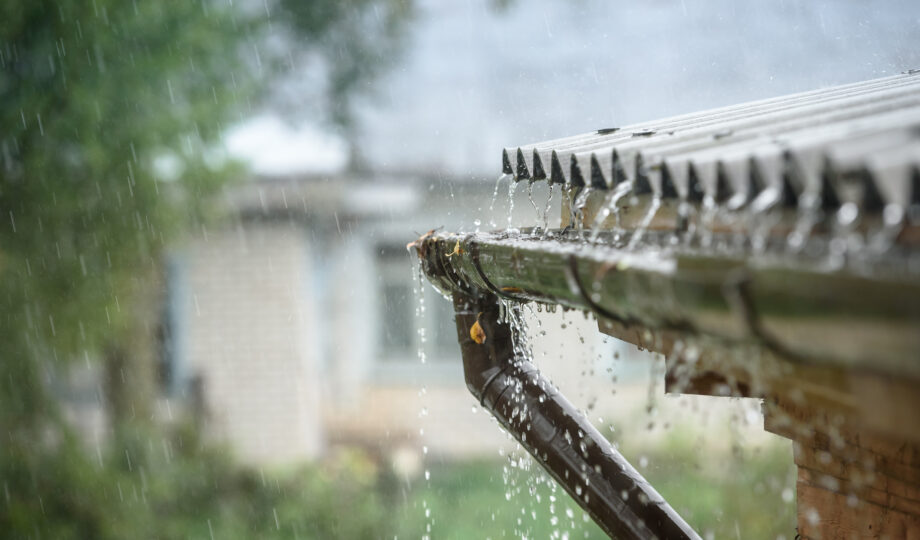
Rainwater has many beneficial properties, both for our general health and for cooking or washing. With a unique pH, rainwater is much less acidic than tap water and has higher levels of nitrogen and oxygen, which helps stimulate the growth of houseplants or garden plants.
Because it is free of limescale, rainwater is much healthier for the body, being perfect for washing hair but also for cooking. The fact that it is free of mineral salts and kept at a temperature of 5-10°C means that rainwater does not develop microorganisms.
If we want to collect rainwater, it is necessary to arrange some clean containers so as not to lose its properties. With the help of gutters and special containers, rainwater can be collected and used without problems. Rainwater should be stored at temperatures of maximum 10°C, in a place without light and, of course, covered.

Why is rainwater harvesting important?
Collecting rainwater in your garden is a very eco-friendly way to keep your plants, flowers and vegetable crops well and healthily watered. Since the conservation is completely free, you will notice the savings on your household water bill.
When you think about rainwater, you should not only refer to simply watering the garden but also to collecting rainwater to use it to water plants throughout the year.
Experts suggest collecting rainwater and using it for the frequent situations that have occurred recently when drought can cause problems with water supply.
What is a rainwater collection container?
Rainwater harvesting requires a container that allows the water flowing from the roof gutters to be collected for non-potable uses, such as watering garden plants. These are usually placed under the downspout.
It is good that at the bottom, about 10 cm from the bottom, the container is equipped with a spout or tap, which allows drainage, possibly connecting to a hose, to be used for spraying. This space is practical for settling dust and other sand particles carried from the roof or gutters washed by rainwater.
If you want to pour the water into a bucket, it must be able to fit under the jug. That’s why it’s a good idea to place the container on a higher stand to allow for the bucket to be placed.
Approximately how big should the container be for collecting rainwater?
The capacity of the barrel or container for collecting rainwater, of course, depends on the amount of rainfall in the area you are in. Secondly, the capacity of the “rain barrel”, that is, the container for collecting rainwater that we will use, depends on our needs for watering the plants.
During a dry period, the amount of water used will be greater to keep the plants happy, and so you will use all the collected water.
- For terraces or a very small garden, a barrel with a minimum capacity of 100 liters is more than enough.
- Over 200 l is needed for small and medium-sized gardens.
- Over 500 l for large gardens.

How to collect rainwater correctly
Pay special attention to where you place your rainwater collection “barrel .” Even though it has wheels, the weight of this container is heavy enough to make it very difficult to move.
- You need to make sure that the surface it is placed on can support the weight of the full bowl.
- It is good for the container to have an overflow that allows excess water to drain when it has been completely filled. If the need for water is greater and it is possible, create a battery of containers, with the overflow of the first feeding a second container.
- It will be located in an area where any water leaks will not reach the foundation of the house.
- The container where rainwater is collected must be stored somewhere in the shade, away from direct sunlight so that it does not heat up too much. At temperatures of maximum 10°C, microorganisms do not proliferate and stinky water does not appear.
- Keep a tight lid on the water container to prevent leaves and other organic debris from getting in and to discourage insects from getting in. This and the lack of light under the lid will also help delay any build-up of microorganisms that contribute to the odor.
- When the gutter drains into the rainwater collection container, a screen that is thick enough to not clog easily but also to not allow insects or leaves collected from the roof and gutters to pass through must be placed.
- Most rainfall will be collected in the winter and spring, then stored for use during the summer, meaning there is a risk of stagnant or foul-smelling water if left for too long. To avoid this, try to use your collected rainwater as regularly as possible and aim to completely empty the container every month.
- It is advisable that at a certain period of time, when the collection container is completely emptied, it be cleaned and sanitized, to avoid the accumulation of microorganisms. Also, periodically, the filters will be cleaned, so that the water has a good flow. The frequency of cleaning depends on local conditions, but also on the season. In spring and autumn there are more leaves, pollen and seed pods that fall.
- If you collect and store rainwater during the winter, you should make sure that you do not fill the container more than three-quarters of its capacity to allow for expansion when freezing and to avoid damaging the container. It is preferable to empty the container at very low temperatures to avoid damage.

What are the benefits of a “rain barrel”?
You save money and reduce your dependence on municipal sources. The amount will vary depending on local water usage and costs.
You make sure you have water on hand during times of drought.
Reduce erosion and carbon footprint by reducing the energy required to move and treat water. Reduce erosion by preventing runoff into the sewer system.
You help protect natural waterways. Excess water from rainfall no longer reaches the local water body in such large quantities, and the system no longer needs countermeasures to balance it.
Help restore local aquifers. In the event of heavy rains, the stormwater system will take the water and carry it to a discharge area that may be far away and not part of the local aquifer.

